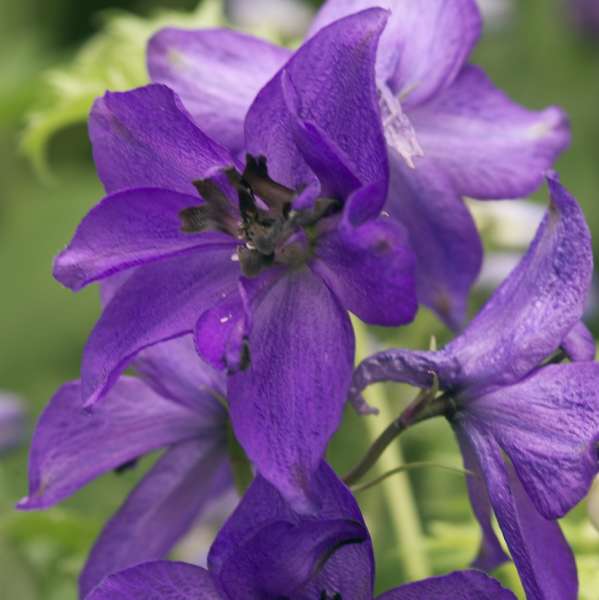
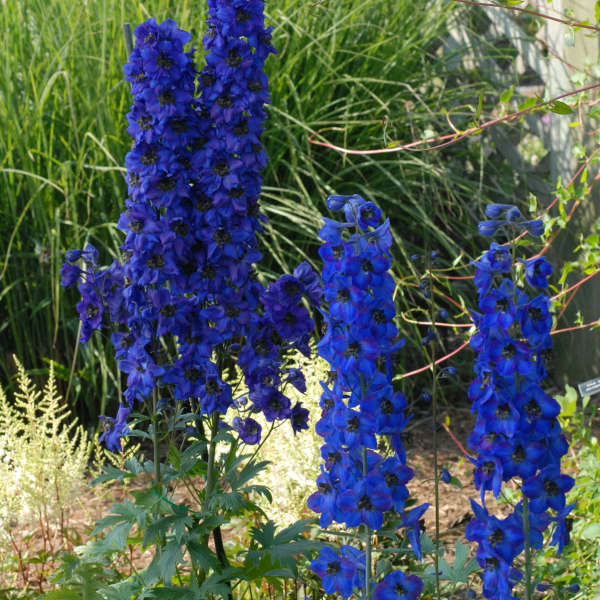
Extremely tall, colorful spikes of deep midnight blue flowers with dark bees rise above distinctively cut leaves in early summer. If the main flower stalk is removed just after flowering, the plant will likely produce secondary blooms in late summer or early fall.
Delphiniums are a distinct class of perennials noted for their tall, stately appearance and true blue colored flowers, a hue that is relatively rare in the perennial world. 'Black Knight' is a Pacific Giant Hybrid, valued for its exceptional height and very deep blue flower color.
Height:
5.0-6.0 Feet
Spread:
18.0-24.0 Inches
Hardiness Zones:
3,4,5,6,7
Flower Color:
Blue shades
Foliage Color:
Green shades
Sunlight:
Full Sun (> 6 hrs. Direct Sun) Part Shade (4-6 hrs. Direct Sun)
Water Requirements:
Average Water Needs
Soil Quality:
Average Soil Quality Fertile Soil Quality
Soil Chemistry:
Neutral Soil (pH = 7.0) Alkaline Soil (pH > 7.0)
Bloomtime:
Early Summer Midsummer Late Summer
Attracts Wings:
Attracts Butterflies Attracts Hummingbirds
Critter Resistant:
Deer Resistant Rabbit Resistant
Seasonal Interest:
Dried Seed Heads
Growth Rate:
Medium
Garden Style:
Cottage Eclectic
Other Features:
Border Plant Cut Flower Cut Foliage Dried Flower Mass Planting Specimen Focal Point
Origin:
Not Native to North America
Delphiniums thrive in the cooler climates of the north country, though they will grow as far south as zone 7. They grow best in rich, well-drained soil with a basic pH. If your soil is naturally acidic, adding lime will help to provide these conditions. They are also heavy feeders. The addition of compost or manure to the soil as well the use of granular fertilizer will result in healthier, stronger plants.
Delphiniums can be grown in full sun or partial shade, though full sun may help to prevent powdery mildew. When planting, be sure to set the crown at or above soil level to avoid rot. Since their stems are hollow, taller varieties of Delphiniums should be staked to prevent damage from wind and rain. These perennials tend to be short-lived and often start to lose their vigor after 2-3 years. Expect to replant them every few years or propagate new plants from basal cuttings of the original specimens.
Height:
5.0-6.0 Feet
Spread:
18.0-24.0 Inches
Hardiness Zones:
3,4,5,6,7
Flower Color:
Blue shades
Foliage Color:
Green shades
Sunlight:
Full Sun (> 6 hrs. Direct Sun) Part Shade (4-6 hrs. Direct Sun)
Water Requirements:
Average Water Needs
Soil Quality:
Average Soil Quality Fertile Soil Quality
Soil Chemistry:
Neutral Soil (pH = 7.0) Alkaline Soil (pH > 7.0)
Bloomtime:
Early Summer Midsummer Late Summer
Attracts Wings:
Attracts Butterflies Attracts Hummingbirds
Critter Resistant:
Deer Resistant Rabbit Resistant
Seasonal Interest:
Dried Seed Heads
Growth Rate:
Medium
Garden Style:
Cottage Eclectic
Other Features:
Border Plant Cut Flower Cut Foliage Dried Flower Mass Planting Specimen Focal Point
Origin:
Not Native to North America
Delphiniums thrive in the cooler climates of the north country, though they will grow as far south as zone 7. They grow best in rich, well-drained soil with a basic pH. If your soil is naturally acidic, adding lime will help to provide these conditions. They are also heavy feeders. The addition of compost or manure to the soil as well the use of granular fertilizer will result in healthier, stronger plants.
Delphiniums can be grown in full sun or partial shade, though full sun may help to prevent powdery mildew. When planting, be sure to set the crown at or above soil level to avoid rot. Since their stems are hollow, taller varieties of Delphiniums should be staked to prevent damage from wind and rain. These perennials tend to be short-lived and often start to lose their vigor after 2-3 years. Expect to replant them every few years or propagate new plants from basal cuttings of the original specimens.
Perennial Encyclopedia •
Proven Winners® •
Find a Retailer •
Gardener's Corner •
Video
www.waltersgardens.com • www.perennialresource.com • www.provenwinners.com
Privacy Notice
Like Us on Facebook