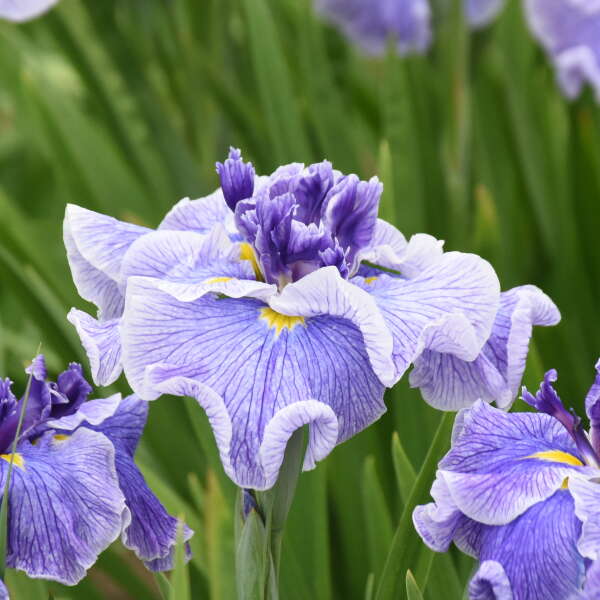
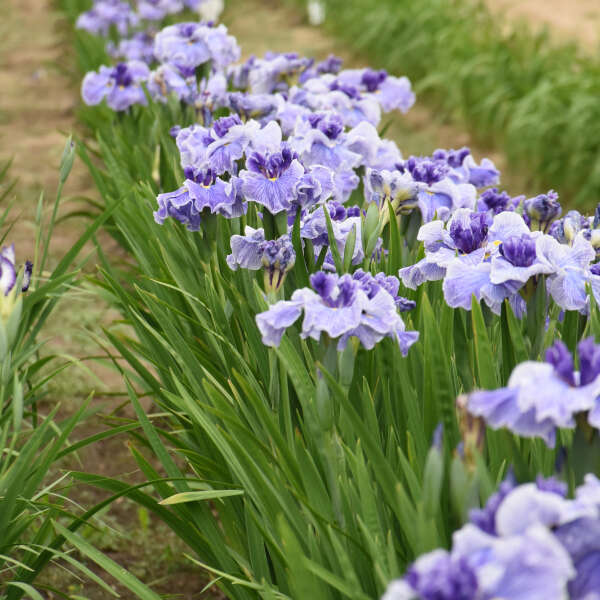
Transform your garden with the striking beauty of Iris ensata 'Center of Attention'. This Japanese Iris features large, violet-blue flowers with ruffled edges and dark purple signals, creating a mesmerizing focal point. Blooming later than Siberian Iris, 'Center of Attention' graces your garden with its presence, extending the iris season.
Unlike the Tall Bearded Iris, the beardless Japanese Iris has a flat bloom, narrower leaves, and smaller, more compact rhizomes. They have the largest flowers of all irises, and make wonderful spring accents for the edge of water gardens. Japanese irises are the latest to bloom, about a month after the Siberian irises.
Height:
36.0 Inches
Spread:
24.0-28.0 Inches
Hardiness Zones:
4,5,6,7,8,9
Flower Color:
Blue shades
Foliage Color:
Green shades
Sunlight:
Full Sun (> 6 hrs. Direct Sun) Part Shade (4-6 hrs. Direct Sun)
Water Requirements:
Consistent Water Needs
Soil Quality:
Average Soil Quality
Soil Chemistry:
Neutral Soil (pH = 7.0) Alkaline Soil (pH > 7.0)
Bloomtime:
Early Summer
Attracts Wings:
Attracts Hummingbirds
Critter Resistant:
Deer Resistant Rabbit Resistant
Growth Rate:
Medium Rapid
Garden Style:
Asian Cottage Eclectic
Other Features:
Border Plant Cut Flower Mass Planting Specimen Focal Point
Origin:
Not Native to North America
Above all else, no other factor is a greater influence on Japanese Irises than water. A lack of moisture will stunt the plants and flowers, while a consistent supply of water will result in large, healthy plants with large flowers. They are lovely planted beside ponds or near streams where the water table is high, but not covering the roots. Mulch the plants heavily to ensure that the soil never dries out.
Japanese Irises should be planted in heavy, acidic, rich soil that has been amended with compost or manure. For new plantings, do not add granular fertilizer around your newly planted irises. Instead, add the fertilizer to the soil a month or two before planting the Japanese Irises. Once established, fertilize them in early spring and again right after they are finished blooming.
Most Japanese Irises require division every 3-4 years. When dividing mature clumps in spring or fall, it is best to dig up the entire clump and replant the divisions somewhere else in the garden where Japanese Irises have not been grown before. The rhizomes should be planted 2-3 inches deep. New roots form above the old roots each year, so by the time you can see the roots growing at the soil surface, it's time to divide them again.
Height:
36.0 Inches
Spread:
24.0-28.0 Inches
Hardiness Zones:
4,5,6,7,8,9
Flower Color:
Blue shades
Foliage Color:
Green shades
Sunlight:
Full Sun (> 6 hrs. Direct Sun) Part Shade (4-6 hrs. Direct Sun)
Water Requirements:
Consistent Water Needs
Soil Quality:
Average Soil Quality
Soil Chemistry:
Neutral Soil (pH = 7.0) Alkaline Soil (pH > 7.0)
Bloomtime:
Early Summer
Attracts Wings:
Attracts Hummingbirds
Critter Resistant:
Deer Resistant Rabbit Resistant
Growth Rate:
Medium Rapid
Garden Style:
Asian Cottage Eclectic
Other Features:
Border Plant Cut Flower Mass Planting Specimen Focal Point
Origin:
Not Native to North America
Above all else, no other factor is a greater influence on Japanese Irises than water. A lack of moisture will stunt the plants and flowers, while a consistent supply of water will result in large, healthy plants with large flowers. They are lovely planted beside ponds or near streams where the water table is high, but not covering the roots. Mulch the plants heavily to ensure that the soil never dries out.
Japanese Irises should be planted in heavy, acidic, rich soil that has been amended with compost or manure. For new plantings, do not add granular fertilizer around your newly planted irises. Instead, add the fertilizer to the soil a month or two before planting the Japanese Irises. Once established, fertilize them in early spring and again right after they are finished blooming.
Most Japanese Irises require division every 3-4 years. When dividing mature clumps in spring or fall, it is best to dig up the entire clump and replant the divisions somewhere else in the garden where Japanese Irises have not been grown before. The rhizomes should be planted 2-3 inches deep. New roots form above the old roots each year, so by the time you can see the roots growing at the soil surface, it's time to divide them again.
Perennial Encyclopedia •
Proven Winners® •
Find a Retailer •
Gardener's Corner •
Video
www.waltersgardens.com • www.perennialresource.com • www.provenwinners.com
Privacy Notice
Like Us on Facebook